
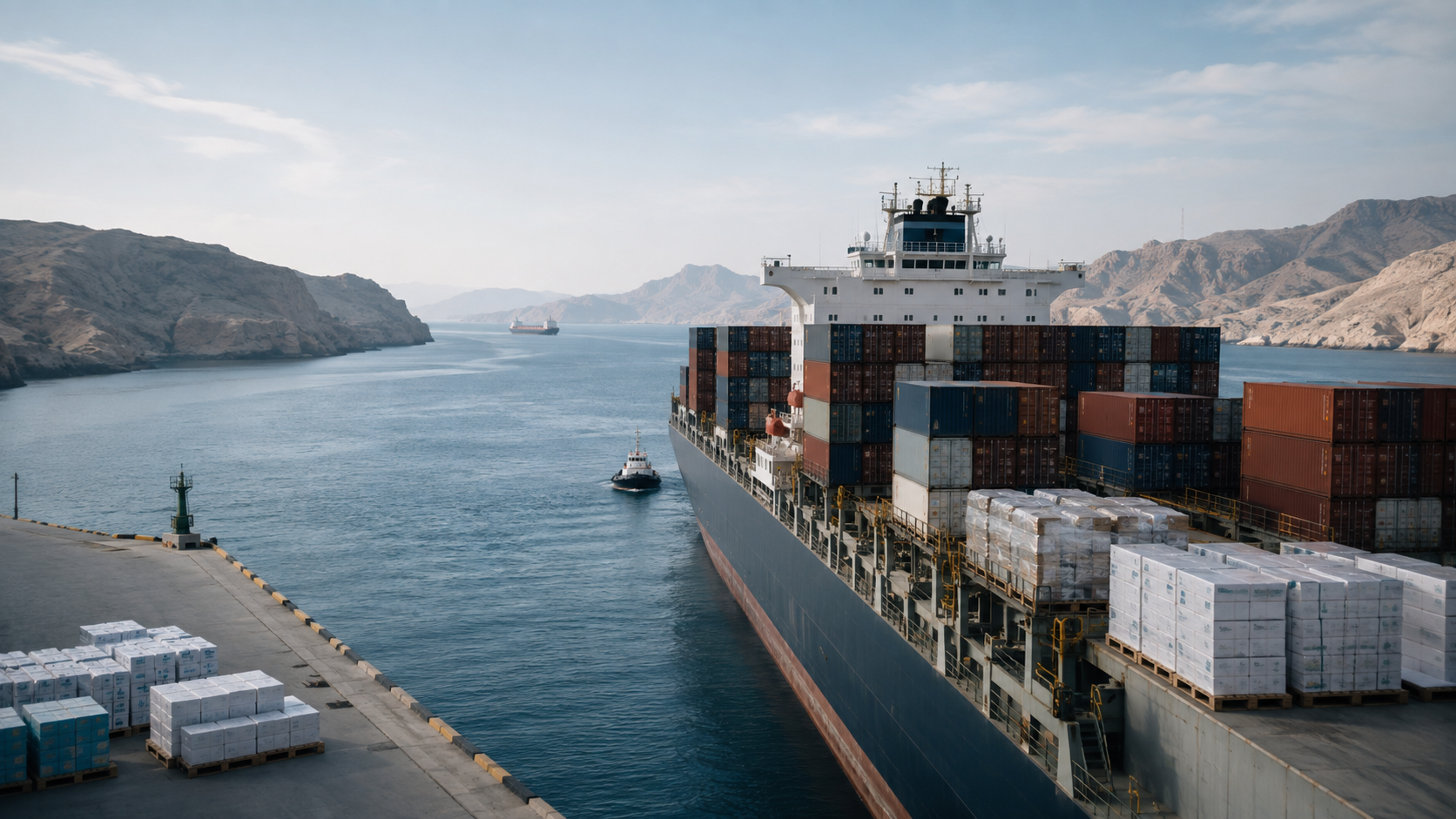
A narrow stretch of water between Iran and Oman has become one of the most consequential variables in global medicines logistics. Since late February 2026, restricted transit through the waterway has placed the Strait of Hormuz supply chain under a level of scrutiny it has never previously received. It has also exposed how much of modern medicine manufacturing rests on energy and petrochemical flows that most supply chain maps never show.
This article sets out what is happening, what it means in practical terms for wholesalers, pharmacists, regulatory affairs teams and healthcare procurement professionals, and what proportionate mitigation looks like.
Key Takeaways
- The Strait of Hormuz supply chain risk is indirect: the route carries energy and petrochemical feedstocks that medicine manufacturing depends on.
- Rerouting around the Cape of Good Hope adds roughly 10–14 days to affected Asia–Europe voyages, with knock-on effects on cost, cold chain risk and inventory cover.
- Off-patent medicines carry the most exposure because they operate on thin margins, lean inventory and concentrated manufacturing.
- Good Distribution Practice obligations do not relax because logistics get harder. Longer transit times increase, rather than reduce, the compliance burden on wholesalers.
- Mitigation is mostly administrative: supply chain mapping, dual sourcing, qualified alternative routes and realistic inventory policy.
Why the Strait of Hormuz Supply Chain Matters to Pharma
The Strait of Hormuz is the world’s most significant oil transit chokepoint. The International Energy Agency notes that around 20 million barrels per day of crude oil and oil products moved through it in 2025, alongside a substantial share of global liquefied natural gas trade. The U.S. Energy Information Administration’s chokepoint analysis puts recent flows at roughly one-fifth of global petroleum liquids consumption and around a quarter of all seaborne traded oil, and observes that existing bypass pipelines could carry only a fraction of that volume.
Very few finished medicines are shipped through the strait. That is exactly why the risk was underestimated. The Strait of Hormuz supply chain exposure is indirect, and it runs through three channels:
Petrochemical feedstocks. Solvents, reagents, excipients and packaging polymers are overwhelmingly petroleum-derived. Glycerin, phenol derivatives, isopropyl alcohol, methanol and monoethylene glycol all trace back to hydrocarbon processing. Around a third of global seaborne methanol trade normally passes through the strait, and monoethylene glycol underpins a great deal of sterile packaging and container manufacture.
Energy costs at the plant. API synthesis, sterile manufacturing, fill-finish and cold storage are energy-intensive. Sustained increases in oil and gas prices feed directly into unit cost, particularly for high-volume generics.
Regional logistics hubs. Gulf ports and airports function as consolidation points for time-sensitive ingredients and finished dosage forms moving between Asia and Europe. Disruption to Gulf airspace, port operations or belly-cargo capacity affects lanes that never touch the strait itself.
The concentration risk sits upstream. India supplies a majority of the world’s generic medicines and, as the Observer Research Foundation has analysed, imports the large majority of its crude oil from West Asia, with a substantial proportion transiting Hormuz. An event that raises Indian manufacturing input costs is an event that raises the cost of UK generic medicines, whatever route the finished product ultimately takes.
What Changed in the Strait of Hormuz Supply Chain Since February 2026
Commercial transit through the strait has been heavily restricted since 28 February 2026, following military escalation in the region. The position has not been static: there have been ceasefire periods and negotiated frameworks during which traffic partially resumed, followed by renewed restriction. As of late July 2026, transit volumes remain far below pre-crisis norms and carriers continue to apply route-risk assumptions to Gulf-linked lanes.
Two features distinguish this episode from earlier chokepoint events:
Two corridors were compromised at once. Renewed attacks on Red Sea shipping coincided with the Hormuz restriction, removing the alternative that carriers relied on during previous disruptions.
Duration has outrun the industry’s planning assumptions. Most contingency models treated chokepoint closure as a short-lived event. A multi-month disruption produces qualitatively different effects: inventory depletion, contract renegotiation and supplier requalification rather than simple rerouting.
How the Strait of Hormuz Supply Chain Raises Distribution Costs
Four separate cost mechanisms are operating simultaneously, which is why the impact is larger than any single one of them would suggest.
Ocean Freight and Rerouting
Diverting around the Cape of Good Hope adds materially to distance, fuel burn and voyage duration. Industry reporting through 2026 has consistently placed the addition at 10–14 days per affected Asia–Europe or Asia–US East Coast voyage, with emergency surcharges applied across Gulf-linked corridors. Longer round trips also absorb vessel capacity, which tightens space on lanes that are not directly affected.
Air Freight and Belly Capacity
Curtailed operations at Gulf hub airports removed a meaningful share of the belly-cargo capacity that time-critical pharmaceutical shipments rely on. Air freight is the default mitigation when sea freight slows, which means it is the first thing to become expensive and constrained in exactly the scenario where it is most needed.
War-Risk Insurance
Marine war-risk premiums for transits in and around the affected area rose sharply from their normal baseline. These charges are typically passed through to shippers, and they apply per voyage, so they compound with rerouting costs rather than substituting for them.
Input and Feedstock Costs
Higher crude and petrochemical prices flow into solvents, excipients and packaging. Because logistics and inputs represent a significant share of the delivered cost of a low-margin generic, a freight and feedstock shock transmits into medicine pricing far faster than it does in most other sectors.
Cold Chain, Quality and GDP Risks from Longer Transit
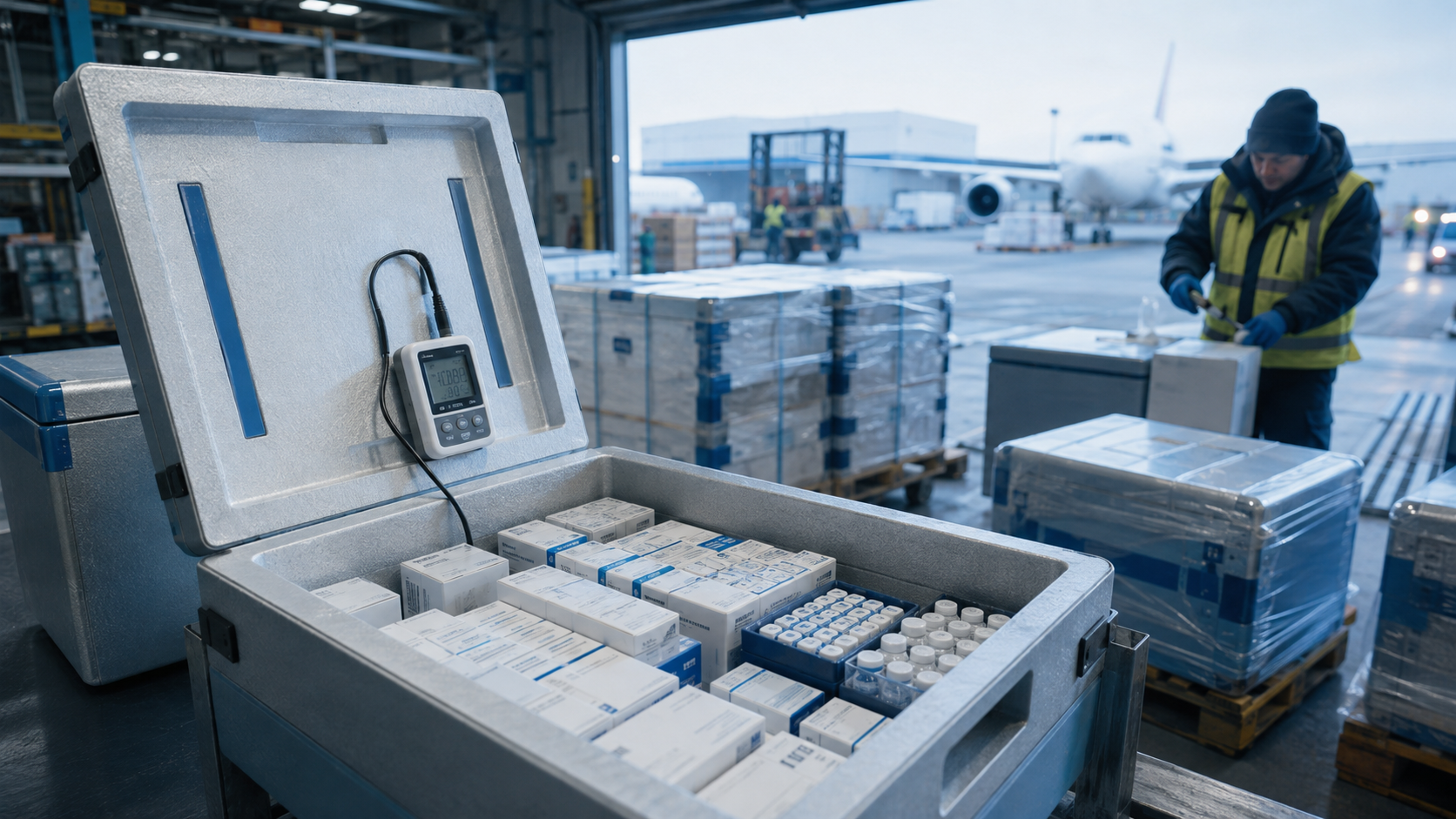
For wholesalers, the compliance dimension is where operational disruption becomes regulatory risk. Extended transit and unplanned transhipment are precisely the conditions under which temperature excursions occur.
Relevant considerations include:
Qualified shipping lanes may no longer reflect reality. A validated route via one corridor does not automatically transfer to a Cape of Good Hope routing with different duration, ambient conditions and handling points.
Passive systems have finite duration. Shippers qualified for a defined transit window may be outside their validated envelope on a longer voyage, requiring requalification or a change of packaging solution.
Temperature excursion review workload increases. More excursions mean more investigations, more product-quality decisions and more pressure on Responsible Person capacity.
Substituting a raw material triggers change control. Vendor qualification, notification and, where applicable, stability or retesting work add weeks or months on top of the shipping delay itself.
The MHRA’s expectations for wholesale distribution are set out in its published guidance on Good Manufacturing Practice and Good Distribution Practice, with licensing requirements described in the guidance on applying for manufacturer or wholesaler of medicines licences. Operational difficulty is not, in itself, a basis for departing from those obligations. Any flexibility in a supply emergency is a matter for the competent authority to determine and communicate; distributors should plan on the basis of existing requirements and document decisions carefully, so that the rationale for any deviation is defensible at inspection.
The UK Picture: How Medicine Supply Issues Are Managed
The UK has an established framework for identifying and managing medicine supply problems, and understanding it is useful for anyone in the wholesale or pharmacy chain.
Manufacturers and marketing authorisation holders have reporting duties. The Department of Health and Social Care sets out how supply disruption and discontinuation must be notified, alongside its wider resilience work, in its policy paper on managing a robust and resilient supply of medicines.
Medicine Supply Notifications communicate issues to the system. NHS England publishes a guide to the systems and processes for managing medicines supply issues in England, covering notification routes, the Medicines Supply Tool and escalation pathways.
Serious Shortage Protocols provide a dispensing mechanism. Where DHSC determines that a serious shortage exists, an SSP may allow a pharmacist to supply an alternative in accordance with the protocol. The NHS Business Services Authority maintains the SSP guidance and current list.
Export restrictions may apply to specific products. DHSC maintains and periodically reviews a list of medicines that may not be exported or hoarded because they are needed for UK patients. Any wholesaler engaged in export must check the current list before each transaction. This is one of the most consequential compliance checks in the sector, and the list changes.
Trade body guidance provides useful context. The ABPI summarises industry-facing shortage management arrangements in its overview of managing medicine shortages.
Structural context matters here too. The UK manufactures only a minority of the medicines it consumes, and off-patent products account for the overwhelming majority of NHS prescriptions. Professional commentary, including analysis published by The Pharmaceutical Journal, has argued that medicines security warrants treatment as a national resilience priority rather than a purely commercial matter. That is a policy debate rather than a settled position, but it is the debate the sector is now having.
Strait of Hormuz Supply Chain Scenarios
Because the Strait of Hormuz supply chain exposure is indirect, its effects arrive on a lag and build over time. Scenario planning is therefore more useful than forecasting: it produces decisions rather than predictions. The scenarios below are a planning aid, not a projection of what will occur.
Short Disruption: 1–4 Weeks
Logistics effect. Reroutes add roughly one to two weeks per affected voyage, while air detours lengthen flight times.
Manufacturing and lead time. Existing inventory absorbs most of the shock; the first pressure appears in high-volume lines.
Commercial impact. Freight surcharges and war-risk premiums are applied, with limited price movement at product level.
Proportionate response. Draw on safety stock, prioritise clinically critical lines, confirm war-risk cover and increase supplier check-in frequency.
Medium Disruption: 1–3 Months
Logistics effect. Rerouting becomes the operating norm, while port congestion and container imbalance emerge.
Manufacturing and lead time. API and intermediate lead times extend, and contract manufacturing slots slip.
Commercial impact. Input and freight costs feed into pricing, particularly for low-margin generics; cold-chain logistics costs rise disproportionately.
Proportionate response. Qualify alternative suppliers and routes, extend inventory cover on critical lines and renegotiate lead-time assumptions in contracts.
Long Disruption: 3–12 Months
Logistics effect. Longer routings are priced in as the baseline and networks are redesigned.
Manufacturing and lead time. Requalification and reformulation cycles add months, while some production relocates.
Commercial impact. The cost base increases on a sustained basis and margins compress across off-patent portfolios.
Proportionate response. Implement structural supplier diversification, strategic stock policy, longer-horizon contracting and a formal supply chain risk register.
Practical Mitigations for Pharmaceutical Wholesalers
The following measures have proved most useful in comparable disruptions. Most are administrative rather than capital-intensive.
- Map your supply chain beyond tier one. The dependency that causes the problem is usually two or three tiers upstream: an excipient, solvent or packaging polymer, not the API you already track.
- Identify single points of failure by product, not by supplier. A diversified supplier list is worth little if all suppliers draw on the same upstream feedstock or corridor.
- Dual-source critical materials in advance. Qualification takes time. Starting the process during a shortage means arriving late.
- Re-run inventory policy against realistic lead times. Cover calculated on pre-disruption transit assumptions overstates your actual position.
- Qualify alternative shipping lanes before you need them. Include the longer routing in temperature mapping and shipper qualification work.
- Review passive packaging duration limits. Confirm that qualified shippers cover the worst-case transit window, not only the planned one.
- Build route flexibility into freight contracts. Contractual optionality between corridors is more valuable than a marginally better rate on a single lane.
- Confirm war-risk insurance scope and exclusions. Understand what is covered, at what premium and on what notice terms.
- Strengthen supplier communication cadence. Early notification of a delay is far more actionable than an accurate explanation after the fact.
- Check export restriction status before every export transaction. Treat this as a mandatory gate in the order process, not a periodic review.
- Document decisions contemporaneously. Where disruption forces a judgement call, the quality of the written rationale determines how it looks at inspection two years later.
- Stress-test the plan. A tabletop exercise on a four-week supply interruption reliably surfaces gaps that a written policy does not.
For an overview of how Logan Pharma approaches these controls in practice, visit our services overview and learn more about Logan Pharmaceuticals.
What the Disruption Means for Procurement and Export Decisions
Three practical shifts follow from the last several months.
Lead time is now a quality parameter, not just a commercial one. Where transit duration affects the validated condition of a temperature-sensitive product, procurement decisions carry quality consequences. Purchasing and quality functions need to make these decisions together.
Price stability assumptions need revisiting. Multi-year fixed pricing built on pre-2026 freight and feedstock assumptions carries meaningful risk. Indexation, review clauses or shorter terms are worth considering.
Supplier due diligence should extend to resilience, not only compliance. Licence verification and GDP standing remain the baseline. Beyond that, questions about feedstock origin, alternative routing and inventory policy now materially affect whether a supplier can actually deliver.
Strait of Hormuz Supply Chain FAQs
Does the Strait of Hormuz Carry Medicines to the UK?
Directly, very little. The Strait of Hormuz supply chain relationship is almost entirely indirect. It carries the oil, gas and petrochemical feedstocks that pharmaceutical manufacturing depends on, and the surrounding region hosts logistics hubs used for consolidation and air freight.
Which Medicines Are Most Exposed?
Generally, high-volume off-patent products. They combine thin margins, lean inventory, concentrated manufacturing and heavy reliance on petrochemical-derived inputs and packaging. Products requiring strict temperature control carry additional risk because longer transit raises excursion probability.
How Much Warning Does the Supply Chain Get?
Less than people expect. Wholesale inventory across the sector is typically measured in weeks rather than months, so an upstream interruption can reach the dispensing counter within a relatively short window.
Do Good Distribution Practice Requirements Change During a Supply Crisis?
Wholesalers should plan on the basis that their existing obligations continue to apply in full. Any regulatory flexibility is a matter for the competent authority to determine and communicate publicly; it should never be assumed.
What Is the Most Useful Action a Distributor Can Take Now?
Map dependencies beyond the first tier and identify where multiple suppliers share the same upstream exposure. Almost every other useful mitigation depends on having done this first.
Building a More Resilient Pharmaceutical Supply Chain
The lesson of 2026 is not that the industry failed to plan. It is that the plans assumed disruption would be brief, geographically contained and confined to a single corridor. None of those assumptions held.
The Strait of Hormuz supply chain has made a general point specific: pharmaceutical logistics depends on energy systems, and energy systems depend on geography. Resilience comes from visibility into those dependencies, genuine alternatives that have been qualified before they are needed, and inventory policy honest enough to reflect real lead times.
Work With Logan Pharma
Logan Pharmaceuticals Limited is a UK-based pharmaceutical wholesaler operating under a Wholesale Dealer’s Authorisation, WDA(H). We support pharmacies, healthcare providers, distributors and international partners with compliant wholesale supply, export solutions and supply chain continuity, with Good Distribution Practice at the centre of how we operate.
If your organisation is reviewing supplier resilience, sourcing alternatives for constrained lines or planning export activity in a volatile logistics environment, we would welcome the conversation.
Explore Logan Pharma’s pharmaceutical wholesale and export services.
This article is provided for general information for supply chain, pharmacy and regulatory professionals. It does not constitute regulatory, legal or clinical advice, and it does not represent the position of any regulator or government body. Readers should refer to current MHRA, DHSC and NHS guidance, and take their own advice before acting. Information is accurate as at 28 July 2026; circumstances in the region have changed repeatedly and may have changed again.


