
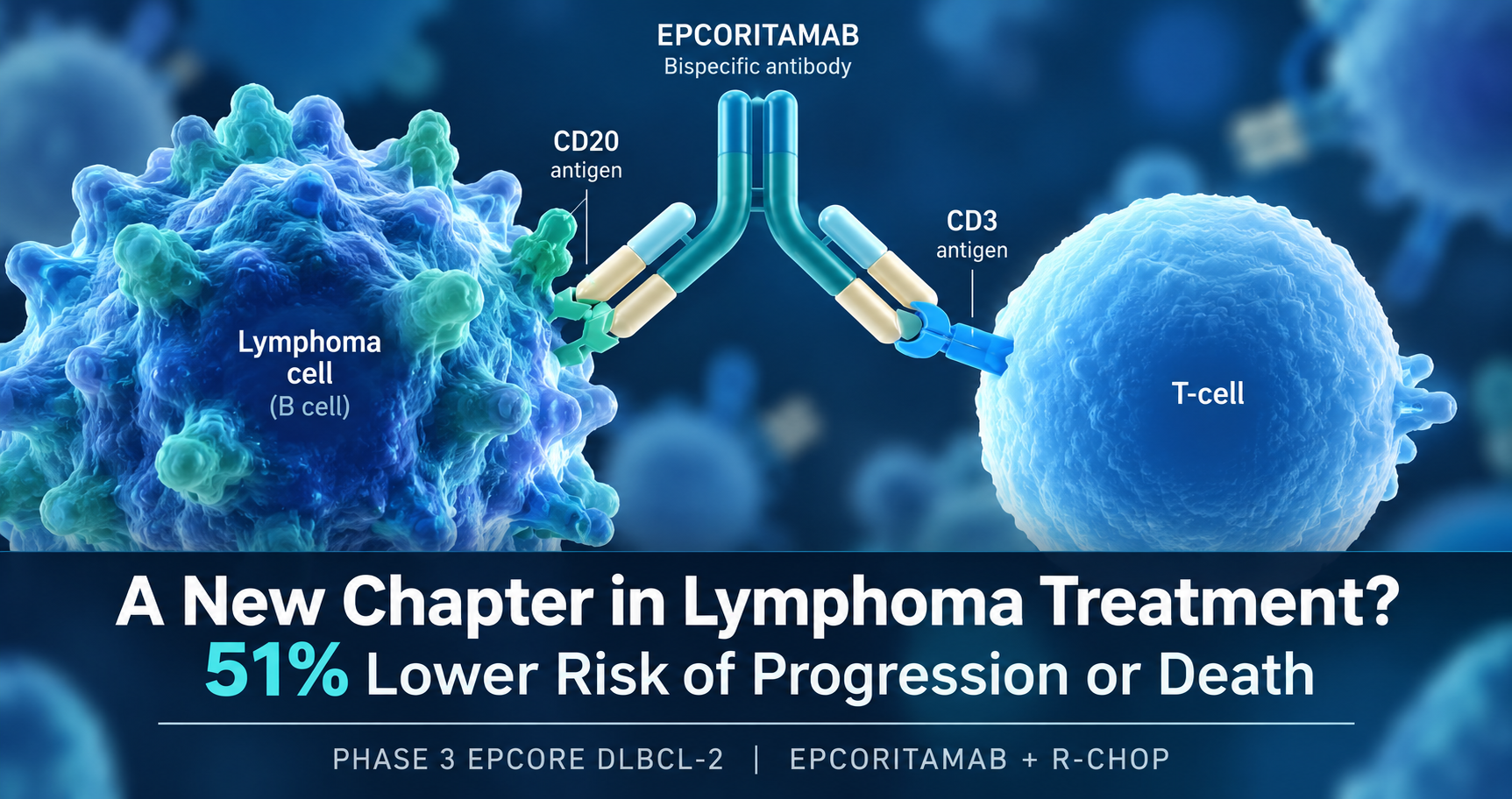
October 2026, AbbVie and Genmab announced positive topline results from the Phase 3 EPCORE DLBCL-2 trial, which tested Epcoritamab combined with R-CHOP against R-CHOP alone in newly diagnosed diffuse large B-cell lymphoma (DLBCL). The combination reduced the risk of disease progression or death by 51%. Based on that benefit at the first planned interim analysis, the Independent Data Monitoring Committee recommended unblinding the study.
The AbbVie and Genmab lymphoma treatment announcement carries weight beyond the trial itself. DLBCL is the most common type of non-Hodgkin lymphoma worldwide, and the companies describe EPCORE DLBCL-2 as the first Phase 3 study of a bispecific antibody combination to show a statistically significant improvement in progression-free survival in frontline DLBCL. The combination remains investigational and is not approved for this use, and both companies have said they will engage global regulatory authorities on next steps.
What Did the EPCORE DLBCL-2 Phase 3 Trial Report?
EPCORE DLBCL-2 is a global, open-label, multicentre, randomised Phase 3 trial. It compares fixed-duration, subcutaneous Epcoritamab plus R-CHOP with R-CHOP alone in newly diagnosed patients with an International Prognostic Index (IPI) score of 2 to 5. The trial began in February 2023 and is ongoing.
According to the AbbVie announcement, the key topline findings were:
- A 51% reduction in the risk of disease progression or death in the primary endpoint population (IPI 3 to 5; hazard ratio 0.49).
- A consistent 51% reduction in the wider IPI 2 to 5 population, the key secondary endpoint (hazard ratio 0.49).
- Statistical significance in both analyses (p < 0.0001).
- A safety profile described as generally well tolerated and consistent with the previously reported profiles of Epcoritamab and R-CHOP individually.
This was the trial’s first planned efficacy interim analysis. Based on the observed benefit, the Independent Data Monitoring Committee recommended unblinding the study. The companies describe it as the first Phase 3 study of a bispecific antibody combination to show a statistically significant improvement in progression-free survival in frontline DLBCL. Genmab has also published its own announcement of the results.
These are topline results. Detailed data will be submitted for presentation at a future medical meeting, and the full dataset will be needed to interpret the findings properly.
How Was the Trial Designed?
Understanding the design helps readers judge what the results do and do not show.
- Randomisation: Patients were randomised 2:1, meaning twice as many received the Epcoritamab combination as received R-CHOP alone.
- Epcoritamab arm: Six cycles of Epcoritamab plus R-CHOP, followed by two cycles of Epcoritamab alone.
- Comparator arm: Six cycles of R-CHOP, followed by two cycles of rituximab.
- Fixed duration: Treatment was given for a defined period rather than continuing indefinitely.
- Open label: Patients and investigators knew which treatment was being given, which is common in oncology trials but is one factor to consider when interpreting results.
- Patient population: The trial enrolled patients with an IPI score of 2 to 5, including DLBCL not otherwise specified, high-grade B-cell lymphoma with MYC and BCL2 and/or BCL6 rearrangements, follicular lymphoma grade 3B, T-cell/histiocyte-rich large B-cell lymphoma and Epstein-Barr virus-positive DLBCL.
The primary endpoint was progression-free survival in patients with an IPI score of 3 to 5. Progression-free survival in the full IPI 2 to 5 population was the key secondary endpoint.
Key Trial Terms Explained
Clinical trial announcements use terminology that can be unfamiliar outside oncology. A short glossary may help.
- Progression-free survival (PFS): The length of time patients live without their disease worsening. It is an established cancer trial endpoint, but it is not the same as overall survival and does not by itself show that a treatment extends life.
- Hazard ratio (HR): A measure comparing the risk of an event, here progression or death, between two groups. A hazard ratio of 0.49 corresponds to a 51% lower risk in one group relative to the other at any given point in time.
- International Prognostic Index (IPI): A scoring system used in aggressive lymphomas to group patients by risk factors. Higher scores indicate a higher-risk profile.
- Topline results: The headline findings released before the full dataset is analysed and peer reviewed.
- Interim analysis: A planned analysis carried out before a trial is complete, often reviewed by an independent committee.
- Bispecific antibody: An antibody engineered to bind two different targets at the same time.
What Is Epcoritamab and How Does It Work?
Epcoritamab is a bispecific antibody administered subcutaneously. It is designed to bind two targets at once:
- CD20, a protein found on B cells, including many lymphoma cells.
- CD3, a protein on T cells, the immune cells involved in identifying and destroying abnormal cells.
By bringing T cells close to CD20-expressing cells, Epcoritamab is designed to direct a T-cell-mediated immune response against the cancer. This differs from conventional chemotherapy, which acts on rapidly dividing cells. The National Cancer Institute provides further detail on its mechanism and approved uses.
According to the companies, Epcoritamab has received regulatory approval in certain lymphoma indications in more than 65 countries. It is marketed as EPKINLY in the United States and Japan and as TEPKINLY in the European Union. It is co-developed by AbbVie and Genmab, with AbbVie responsible for further global commercialisation.
In EPCORE DLBCL-2, Epcoritamab was given alongside R-CHOP, a regimen of rituximab, cyclophosphamide, doxorubicin, vincristine and prednisone that has long been a standard option for DLBCL. The trial asked whether adding a bispecific antibody to this regimen could improve outcomes, rather than replacing it.
Why Do These Results Matter for Diffuse Large B-Cell Lymphoma?
DLBCL is the most common type of non-Hodgkin lymphoma worldwide, accounting for roughly 25 to 30 per cent of cases according to the companies. They also report approximately 25,000 new diagnoses each year in the United States. DLBCL can arise in lymph nodes or in organs outside the lymphatic system, occurs more commonly in older adults and is a fast-growing cancer, so effective first-line treatment is particularly important. Background information is available from the NHS and the National Cancer Institute.
Treatment advances have improved outcomes, but many patients still relapse or do not respond. The announcement is noteworthy for three reasons:
- It explores an earlier line of treatment. Epcoritamab is already approved for certain relapsed or refractory lymphoma indications in a number of markets, as described in the FDA’s approval information. This trial studies newly diagnosed patients.
- It builds on an established regimen. Adding a new agent to R-CHOP tests whether outcomes can improve without abandoning a familiar backbone therapy.
- It adds to bispecific antibody research. The results contribute to the wider investigation of immune-based cancer therapies.
AbbVie and Genmab have suggested the combination could become a potential new standard of care, and an investigator quoted in the announcement described the results as potentially practice-changing. These are the companies’ and investigators’ views at the topline stage. Positive trial results do not automatically establish a new standard of care. Full data, longer follow-up and regulatory review all remain essential.
What Happens After a Positive Phase 3 Result?
A successful Phase 3 trial is a major milestone, but it is not the end of the development pathway. AbbVie and Genmab have said they will engage global regulatory authorities to determine next steps.
Epcoritamab plus R-CHOP is an investigational combination and is not approved by regulatory authorities for newly diagnosed DLBCL.
In the UK, the Medicines and Healthcare products Regulatory Agency (MHRA) assesses the quality, safety and effectiveness of medicines. Other regions have their own authorities and timelines. Typical steps after a positive trial include:
- Presentation of detailed data at a medical meeting and, usually, peer-reviewed publication.
- Preparation and submission of regulatory applications.
- Regulatory assessment of benefits, risks and manufacturing quality.
- Decisions on authorisation, which may differ by country or region.
- Pricing, reimbursement and health technology assessment processes, where applicable.
- Inclusion in clinical guidelines and adoption into routine practice.
Each stage can take time, and outcomes are not guaranteed. If a new indication is authorised, several practical factors influence how the treatment reaches providers and patients:
- Regulatory requirements: Authorisation and conditions differ between countries and regions.
- Manufacturing capacity: Production must meet quality standards while supporting anticipated demand.
- Distribution and storage: Medicines must be handled, stored and transported according to their specific requirements, which is especially relevant for biologic and cold-chain products.
- Market access: Pricing, reimbursement and local healthcare policy all influence availability.
- Supply continuity: Dependable sourcing and distribution arrangements matter more as treatment practice evolves.
These considerations carry particular weight in oncology, where treatment decisions and medicine availability can have significant consequences for patients.
From Pharmaceutical Innovation to Medicine Access
A new cancer therapy depends on more than scientific discovery. It also relies on the systems that support the medicine from development through to clinical use.
For wholesalers, distributors and procurement teams, developments like this AbbVie and Genmab lymphoma treatment announcement underline the value of understanding changing treatment landscapes, regulatory requirements and the practical challenges of supply. Useful reference points include:
- Licensing and authorisation status: Confirm the regulatory status of any product in the relevant market. Guidance is available through GOV.UK.
- Good Distribution Practice (GDP): Maintain quality and integrity through storage and transport, supported by appropriate documentation.
- Cold-chain management: Many biologic and oncology products require controlled-temperature handling, so product-specific storage requirements should always be checked against the approved product information.
- Documentation and traceability: Accurate records support quality assurance, audits and the investigation of any deviations.
- Pharmacovigilance awareness: Healthcare professionals and patients can report suspected adverse reactions through the MHRA Yellow Card scheme.
Looking Ahead
The positive Phase 3 results for Epcoritamab plus R-CHOP are an encouraging development in the search for better options for newly diagnosed DLBCL. Presentation of the full data, regulatory assessment and consideration within clinical guidelines will determine whether they translate into a new option for patients.
For the industry, the AbbVie and Genmab lymphoma treatment news is also a reminder that progress depends on connected stages: research, clinical validation, regulatory approval and a reliable supply chain capable of supporting access.
Sources
- AbbVie — Official announcement of the EPCORE DLBCL-2 Phase 3 results, 5 October 2026.
https://news.abbvie.com/2026-10-05-AbbVie-and-Genmab-Announce-Epcoritamab-in-Combination-with-R-CHOP-Demonstrates-Significant-Improvement-in-Progression-Free-Survival-versus-R-CHOP-in-Patients-with-Newly-Diagnosed-Diffuse-Large-B-Cell-Lymphoma - Genmab — Official announcement of the EPCORE DLBCL-2 results.
https://www.us.genmab.com/company/news/press-releases/genmab-and-abbvie-announce-epcoritamab-in-combination-with-r-chop-demonstrates-statistically-significant-improvement-in-progression-free-survival-in-patients-with-newly-diagnosed-diffuse-large-b-cell-lymphoma-2026-10 - U.S. Food and Drug Administration — Epcoritamab approval for certain relapsed or refractory lymphoma indications.
https://www.fda.gov/drugs/drug-approvals-and-databases/fda-grants-accelerated-approval-epcoritamab-bysp-relapsed-or-refractory-diffuse-large-b-cell - National Cancer Institute — Epcoritamab: mechanism of action and approved uses.
https://www.cancer.gov/about-cancer/treatment/drugs/epcoritamab-bysp - National Cancer Institute — Aggressive B-cell non-Hodgkin lymphoma treatment information.
https://www.cancer.gov/types/lymphoma/hp/aggressive-b-cell-lymphoma-treatment
This article is for general information only and is not medical, legal or regulatory advice. Product availability and authorisation status vary by region and may change.


