Treating persistent lung infections caused by Mycobacterium avium complex (MAC) can be challenging, especially for patients with limited treatment options. ARIKAYCE liposomal 590 mg offers a specialist treatment approach through an inhaled formulation of the antibiotic amikacin.
Unlike conventional injectable amikacin, ARIKAYCE delivers the antibiotic directly to the respiratory tract through a dedicated nebuliser system. As a result, it has specific administration, safety and handling requirements.
For pharmacists, pharmaceutical wholesalers and regulatory professionals, understanding these requirements is essential. In addition to the medicine’s clinical indication, professionals must consider its storage conditions, regulatory status and distribution requirements.
This article explains the key characteristics of ARIKAYCE liposomal 590 mg. It also highlights practical considerations for pharmaceutical sourcing, wholesale distribution and international supply chains.
What Is ARIKAYCE Liposomal 590 mg?
ARIKAYCE liposomal 590 mg nebuliser dispersion contains amikacin, an aminoglycoside antibiotic that helps treat certain bacterial infections.
The formulation uses liposomes to carry amikacin into the respiratory tract. Therefore, ARIKAYCE differs from conventional injectable amikacin in both its formulation and administration method.
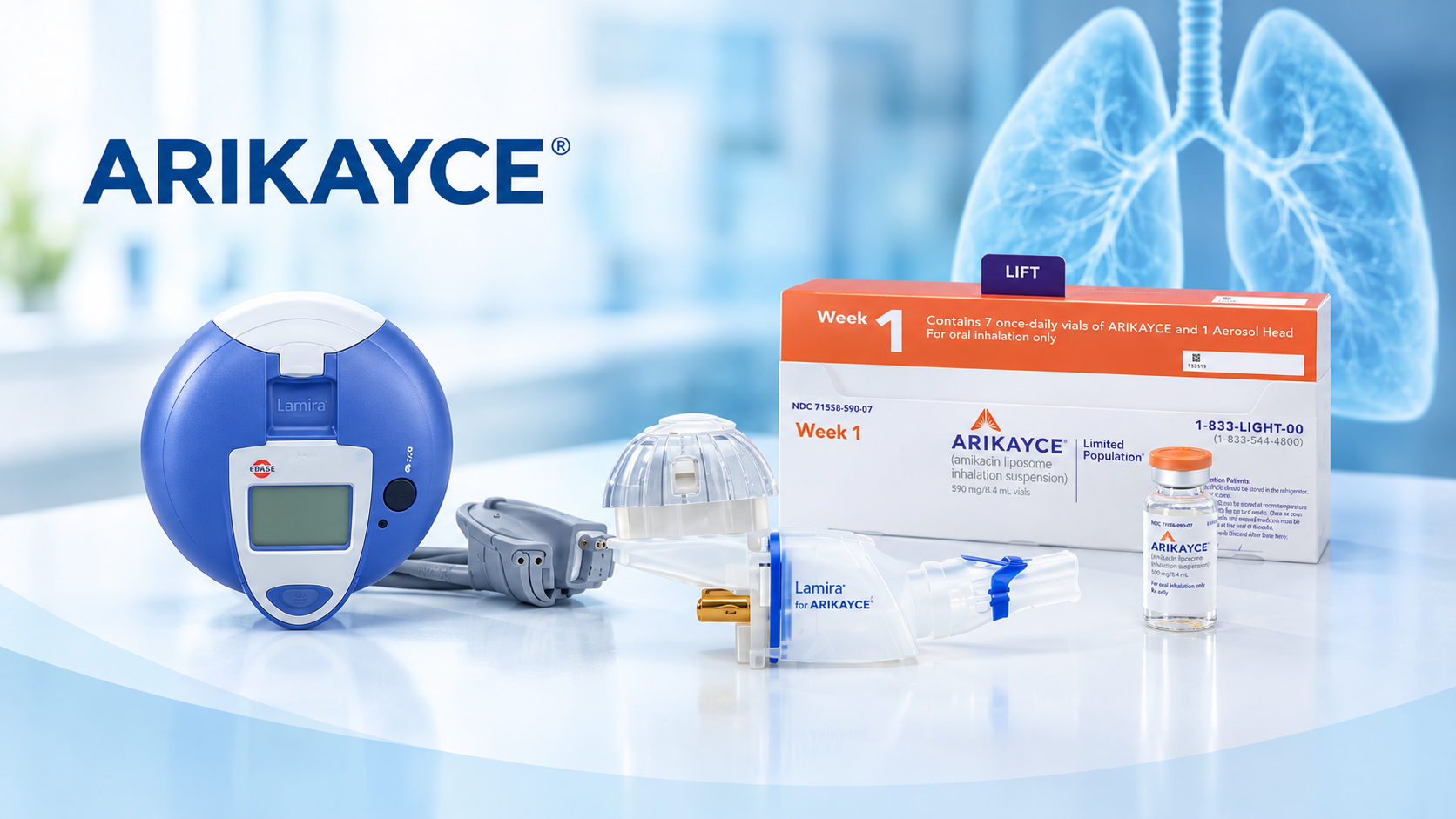
Healthcare professionals administer the medicine through oral inhalation using the dedicated Lamira Nebuliser System.
Key Product Information
| Product characteristic | Details |
|---|---|
| Product name | ARIKAYCE liposomal |
| Active substance | Amikacin (as amikacin sulfate) |
| Strength | 590 mg per vial |
| Pharmaceutical form | Nebuliser dispersion |
| Administration route | Oral inhalation |
| Recommended dose | One vial once daily |
| Administration device | Lamira Nebuliser System |
| UK legal classification | Prescription Only Medicine (POM) |
| Standard storage | Refrigerated at 2°C–8°C |
Each vial contains amikacin sulfate equivalent to 590 mg of amikacin. However, the mean dose delivered from the nebuliser mouthpiece under specified testing conditions is approximately 312 mg.
Importantly, patients must use ARIKAYCE only with the Lamira Nebuliser System. They must not use another inhalation device or administer the medicine through another route.
For complete prescribing and administration information, consult the ARIKAYCE Summary of Product Characteristics (SmPC).
What Is ARIKAYCE Liposomal 590 mg Used For?
ARIKAYCE liposomal treats non-tuberculous mycobacterial (NTM) lung infections caused by Mycobacterium avium complex (MAC).
However, its UK authorisation covers a specific patient population rather than all individuals with NTM lung disease.
The authorised indication applies to adults who:
- Have MAC lung disease.
- Have limited treatment options.
- Do not have cystic fibrosis.
ARIKAYCE must form part of a combination treatment regimen with other antibacterial agents active against MAC. Therefore, clinicians should not prescribe it as a standalone treatment.
Furthermore, physicians experienced in managing NTM lung disease caused by MAC should initiate and oversee treatment.
Treatment Duration and Monitoring
According to the SmPC, treatment should continue for 12 months after sputum culture conversion. However, the overall treatment duration must not exceed 18 months.
Additionally, if clinicians cannot confirm sputum culture conversion by six months, treatment should not continue beyond that point.
These requirements highlight the importance of specialist oversight and regular clinical assessment.
Why Can MAC Lung Disease Be Difficult to Treat?
Non-tuberculous mycobacteria occur naturally in the environment. Although many exposures do not cause disease, certain species can lead to persistent pulmonary infections in susceptible individuals.
MAC represents an important cause of NTM lung disease.
Treatment can be challenging for several reasons:
- Persistent infections: Some patients experience prolonged infections despite treatment.
- Complex treatment regimens: Clinicians often need to prescribe combinations of antibiotics.
- Limited treatment options: Certain patients do not respond adequately to existing therapies.
- Ongoing monitoring: Successful management requires regular clinical and microbiological assessment.
Consequently, some patients need additional treatment approaches.
ARIKAYCE provides one such option for adults who meet its authorised indication. Nevertheless, healthcare professionals must assess each patient’s suitability according to the current product information.
Clinical Evidence Supporting ARIKAYCE
Clinical evidence helps explain the role of ARIKAYCE liposomal 590 mg in managing difficult-to-treat MAC lung infections.
The ARIKAYCE SmPC describes a randomised clinical study that compared two treatment approaches:
- ARIKAYCE liposomal combined with a multidrug regimen (MDR).
- A multidrug regimen without ARIKAYCE.
The study included adults who had not achieved sputum culture conversion despite receiving at least six months of prior treatment.
Key Clinical Findings
By month six, the study reported the following sputum culture conversion results:
- 29.0% of patients receiving ARIKAYCE plus MDR achieved culture conversion.
- 8.9% of patients receiving MDR alone achieved culture conversion.
Therefore, the ARIKAYCE combination group demonstrated a higher culture-conversion rate at this endpoint.
The SmPC also provides information about durable sputum culture conversion after treatment.
However, these findings require careful interpretation. Study results reflect a defined patient population, specific treatment conditions and established clinical endpoints.
Consequently, healthcare professionals should not interpret the percentages as guaranteed outcomes for individual patients.
For further details, consult the European Medicines Agency ARIKAYCE product information.
Important Safety Considerations
Like other aminoglycoside antibiotics, ARIKAYCE has important safety risks that require clinical attention.
The SmPC identifies several warnings and precautions, including:
- Ototoxicity: Potential effects on hearing and balance.
- Nephrotoxicity: Possible kidney-related adverse effects.
- Bronchospasm: Respiratory reactions that may require clinical intervention.
- Hypersensitivity: Allergic reactions, including potentially serious reactions.
- Pulmonary exacerbations: Possible worsening of existing respiratory conditions.
Clinical trials also identified a higher frequency of exacerbations of certain underlying pulmonary conditions among patients receiving inhaled liposomal amikacin compared with those not receiving it.
Therefore, clinicians must consider the patient’s respiratory health when assessing treatment suitability.
Additionally, the SmPC specifies contraindications, including severe renal impairment, hypersensitivity to soya and co-administration with other aminoglycosides.
Healthcare professionals should follow the current SmPC when making treatment and monitoring decisions.
In the UK, they can report suspected adverse drug reactions through the MHRA Yellow Card scheme.
ARIKAYCE Liposomal 590 mg: Storage and Handling Requirements
Appropriate storage plays an important role in maintaining the quality of ARIKAYCE liposomal 590 mg.
The medicine has specific temperature requirements. Therefore, wholesalers, procurement teams and logistics providers must consider these conditions when planning storage and distribution.
Refrigerated Storage Requirements
Under normal conditions, the SmPC requires the following:
- Store ARIKAYCE between 2°C and 8°C.
- Do not freeze the product.
- Discard any vial that has frozen.
Consequently, pharmaceutical distributors must maintain appropriate temperature controls throughout storage and transportation.
Permitted Room-Temperature Storage
The SmPC also permits storage below 25°C for up to four weeks.
However, this allowance has specific limitations. Once the medicine enters room-temperature storage, users must discard any unused product at the end of the four-week period.
Furthermore, this provision does not automatically justify every temperature excursion during distribution.
Quality teams must assess deviations against the current product information, available technical evidence and applicable quality procedures.
Practical Supply-Chain Considerations
Pharmaceutical wholesalers should focus on several areas when managing ARIKAYCE:
- Temperature monitoring: Maintain appropriate storage and transportation records.
- Stock management: Monitor expiry dates and permitted storage periods.
- Temperature excursions: Investigate deviations and document their assessment.
- Product integrity: Confirm that storage and transport conditions remain suitable.
- Traceability: Maintain accurate batch and distribution records.
Together, these measures support product quality and reduce avoidable supply-chain risks.
For more information about our quality-focused approach, explore Logan Pharmaceuticals’ pharmaceutical compliance and quality assurance information.
Pharmaceutical Wholesale and Supply Considerations
Specialist medicines often require additional coordination during procurement and distribution.
For example, pharmaceutical wholesalers must consider regulatory authorisations, supplier qualification, transportation requirements and product documentation.
ARIKAYCE liposomal 590 mg presents several considerations in these areas.
1. Product Authorisation and Market Requirements
Medicines regulations vary between countries. Therefore, pharmaceutical businesses must verify the applicable requirements before arranging supply.
Key checks include:
- Confirming the product’s marketing authorisation status.
- Reviewing relevant import and distribution requirements.
- Verifying applicable wholesale and import licences.
- Checking packaging, labelling and documentation requirements.
- Assessing any additional destination-market obligations.
Importantly, authorisation in one country does not automatically permit supply in another.
As a result, businesses should assess each proposed transaction against the relevant regulatory framework.
2. Supplier Qualification and Product Verification
Reliable pharmaceutical sourcing starts with appropriate supplier qualification.
Before proceeding with an order, wholesalers should confirm the supplier’s regulatory status and relevant authorisations.
Additionally, they should review:
- The proposed supply route.
- Product provenance and traceability.
- Batch numbers and expiry dates.
- Relevant product documentation.
- Applicable quality and distribution requirements.
These checks help maintain transparency throughout the supply chain. Moreover, they support effective investigation if product-quality concerns arise.
3. Storage and International Transportation
ARIKAYCE’s temperature requirements can influence transport planning.
Therefore, logistics teams should evaluate storage conditions, temperature monitoring arrangements and the product’s remaining shelf life before dispatch.
International movements may also involve customs clearance, transit arrangements and additional regulatory documentation.
Consequently, early coordination between suppliers, freight providers and receiving organisations can help reduce avoidable delays.
4. Product Presentation and Administration Equipment
ARIKAYCE requires the Lamira Nebuliser System for administration.
Furthermore, the UK SmPC describes a 28-vial presentation that includes a Lamira Nebuliser Handset and four aerosol heads.
Therefore, procurement professionals should verify the exact pack presentation and relevant device requirements before confirming an order.
Product presentations may differ between markets. As a result, buyers should always check the current documentation for the intended destination.
5. Documentation and Traceability
Accurate documentation supports effective pharmaceutical distribution.
For specialist medicines, relevant records may include:
- Batch and expiry information.
- Supplier and customer qualification records.
- Storage and transportation documentation.
- Product information and regulatory documents.
- Distribution and traceability records.
However, documentation requirements vary according to the product, transaction and destination market.
Therefore, businesses must determine the applicable requirements before completing a supply arrangement.
UK Regulatory Requirements for Pharmaceutical Wholesalers
The Medicines and Healthcare products Regulatory Agency (MHRA) regulates medicines in the UK.
Businesses that undertake wholesale distribution of human medicines generally need the appropriate wholesale distribution authorisation. They must also comply with applicable Good Distribution Practice (GDP) requirements, subject to relevant legal provisions and exemptions.
GDP establishes a framework for maintaining medicine quality throughout storage, handling and distribution.
Key GDP Considerations
Pharmaceutical wholesalers should maintain effective controls covering:
- Supplier and customer qualification.
- Procurement and distribution procedures.
- Storage and transportation conditions.
- Documentation and recordkeeping.
- Complaints, returns and suspected defective medicines.
- Quality management and oversight.
Additionally, organisations involved in international pharmaceutical supply must assess relevant import, export and destination-market requirements.
For more information, visit the UK Government’s guidance on manufacturer and wholesaler licensing.
Supporting Specialist Pharmaceutical Supply Chains
Managing specialist medicines requires more than identifying a potential supplier.
Instead, organisations need a coordinated approach that considers regulatory requirements, product documentation, storage conditions and distribution arrangements.
As pharmaceutical supply chains become increasingly international, effective communication between suppliers, wholesalers and healthcare organisations remains essential.
At Logan Pharmaceuticals, we focus on pharmaceutical wholesale, export and international supply-chain solutions.
Our team works with professional customers and supply-chain partners to support sourcing enquiries, documentation coordination and pharmaceutical supply requirements within applicable regulatory frameworks.
Furthermore, we recognise the importance of product traceability, appropriate supplier qualification and effective quality controls when managing pharmaceutical transactions.
To learn more, visit our About Us page or explore our pharmaceutical wholesale and export services.
You can also read additional industry insights on the Logan Pharmaceuticals blog.
Conclusion
ARIKAYCE liposomal 590 mg provides a specialist inhaled treatment option for a defined group of adults with MAC lung disease.
However, its clinical indication represents only one aspect of the product’s overall requirements.
Pharmacists, wholesalers and regulatory professionals must also consider its dedicated nebuliser system, storage conditions, product documentation and applicable distribution regulations.
Furthermore, international sourcing introduces additional requirements relating to market authorisation, transportation and regulatory compliance.
Ultimately, reliable specialist pharmaceutical supply depends on accurate product information, effective quality management and careful coordination across the supply chain.
Contact Logan Pharmaceuticals
Are you looking for a pharmaceutical wholesale, export or specialist medicine sourcing partner?
Logan Pharmaceuticals supports professional customers with pharmaceutical wholesale, international export and supply-chain solutions.
Whether your organisation needs support with pharmaceutical procurement, international distribution or specialist sourcing enquiries, our team can discuss your requirements and assess appropriate supply options.
Contact Logan Pharmaceuticals to discuss your pharmaceutical sourcing and distribution needs.
Product-specific enquiries remain subject to availability, supplier qualification, applicable authorisations and regulatory requirements.
References and Official Sources
- Electronic Medicines Compendium – ARIKAYCE Liposomal 590 mg SmPC
- European Medicines Agency – ARIKAYCE Liposomal Product Information
- MHRA – Medicines and Healthcare products Regulatory Agency
- GOV.UK – Apply for Manufacturer or Wholesaler of Medicines Licences
- MHRA Yellow Card – Report Suspected Adverse Reactions
Disclaimer: This article provides general information for healthcare and pharmaceutical industry professionals. It does not replace the current SmPC, clinical judgement or applicable regulatory guidance. References to ARIKAYCE do not imply manufacturer endorsement, an official supply relationship or confirmed product availability through Logan Pharmaceuticals. All supply enquiries remain subject to appropriate verification and applicable regulatory requirements.


